

NEWS

Briefing No. 4
Donut economics, blockchain technology and a Trashspresso machine at Somerset House
WHAT WE'RE READING
On the Greenwood Place bedside table
We just finished Doughnut Economics and we've made notes on every chapter we've read.
Kate Raworth's economic model for the 21st Century is an ambitious, radical roadmap for bringing humanity into the sweet spot that meets the needs of all within the means of the planet.

AND WHAT WE'VE BEEN WATCHING
Chasing Coral is a beautifully made and chilling documentation of the environmental catastrophe happening globally now.
Some 40% of the Great Barrier Reef is estimated to have died in 2016 alone due to rising sea temperatures. Over the last 30 years 50% of the coral has disappeared. Based on current trends, within the next 30 years, annual bleaching will have killed most of the world's coral.
Jiro Dreams of Sushi follows the work and life of Jiro Ono, the 85 year old who is recognised by many as the greatest sushi chef alive.
He works every day at his tiny, 10 person, basement restaurant and, he says, "I love making sushi. I enjoy every day." His life lesson? "Immerse yourself in your work. Never complain...dedicate your life to mastering your skill. That's the key to being regarded honourably."
Ikigai is a Japanese word that translates roughly as the happiness of always being busy - doing work that uses your strengths, has an impact, makes a living, and brings joy. It might be translated into French as 'raison d'être.'

IMPACT: MORE AND BETTER
Philanthropy operates in places where systems are broken. Not every good idea or great organisation can or will shift a system, but where there is a chance of moving beyond incremental change to accelerate a solution to one of the world's most pressing problems, surely philanthropy should do everything it can to help.
Scaling Solutions Toward Shifting Systems, a new report from Rockefeller Philanthropy Advisors, investigates the role that funders can play, and how they can either support or constrain the organisations they support through the way that they approach their giving.
BLOCKCHAIN TECHNOLOGY
We've been talking to land rights experts and to mini-grid investors about blockchain technology and its capacity to give agency to the poor. So we were delighted to see that other people are thinking along similar lines. Vinay Gupta and Rob Knight argue that blockchain gives emerging economies an unprecedented opportunity to create transactional security and trustworthy governance infrastructure. Article here.

LAST WORDS: BUILDING THE CIRCULAR ECONOMY
Greenwood Place's home, Somerset House, hosted Pentatonic's Trashspresso machine.
The start-up company manufactures flat pack furniture entirely from rubbish and with traceable, modular components.
And, check out http://preciousplastic.com/ for a step-by-step guide to recycling and repurposing plastic in your shed at home. Maybe this could be your ikigai? Click here
EVENTS AT GREENWOOD PLACE
We thoroughly enjoyed our launch party in September surrounded by so many friends, family, clients and advisors. We were kindly supported by Woven Gold, the choir from the Helen Bamber Foundation who added to the wonderful atmosphere of the evening. We are so grateful to everyone who was able to attend and we look forward sharing and growing our friendships and partnerships on the Greenwood Place journey.


Briefing No. 3
Tim Marshall's Prisoners of Geography, elephants & other extraordinary animals, collaborations & events.
WHAT WE'RE READING
On the Greenwood Place bedside table
We took quite a stack of books on holiday this Summer.
Tim Marshall’s Prisoners of Geography was a great read and a reminder of the salience of geography in international affairs. Ideologies come and go but geography remains….
We also thoroughly enjoyed Progress by Johan Norberg. If- like most of us - you are predisposed to assume that things are worse than they used to be, this book unleashes wave after wave of evidence to the contrary. The main reason why things tend to get better is that knowledge is cumulative and easily shared and as Norberg puts it, “The most important resource is the human brain...which is pleasantly reproducible.”
AND WHAT WE'VE BEEN WATCHING
We were gripped and deeply moved by Ava DuVernay’s film '13th', a piercing documentation of mass incarceration in today’s America, which contains 5% of the world’s population and 25% of its prisoners.
Although we haven’t quite got around to setting up a Greenwood Place film club yet, it’s definitely on our list. Check out Influence Film Club for recommendations of great, thought-provoking documentaries as well as articles and other read-arounds that provide context.

ELEPHANTS AND OTHER EXTRAORDINARY ANIMALS
We were amazed by acoustic biologist Katy Payne’s story of how she discovered the layers of infrasonic communication between elephants and what she has learned from more than 30 years of listening to animals.
It was fascinating to learn how emotional elephants are. Payne says that the excitement when a group of elephants that has been separated for a few hours come back together is "the most marvellous show of total New Year’s Eve, family-reunion excitement". Listen here
Oliver Uberti’s article documenting GPS tracking of elephant travels, and how conservationists are using data to help to reduce human-animal conflict was an interesting complement to the podcast.

ENSEMBLES NOT SOLOISTS
We’re involved in a couple of collaborative ventures here at Greenwood Place. In both cases, informal teams have formed for practical reasons - no single party has all the answers (when exactly does one party have all the answers in any event?) or all the resources needed to reach a successful outcome. So we were very pleased to come across Jeffrey Walker’s piece about collaboration in philanthropy - why it makes sense, when it makes sense and, more importantly, what you can do to maximise its chances of success
ARE YOU A SELF-INTERRUPTER?
As an inveterate email checker, Rebecca was both fascinated and appalled by Adam Gazzaley and Larry Rosen’s recent article in Nautilus about how we use media and technology. One study of 3,048 Dutch teens and adults found that people of all ages multitasked at least a quarter of the time—with teens dual tasking 31 percent of their day. Another study saw UK workers dealing with an email, which itself took an average of just under two minutes, taking an average of 68 seconds to return to their work and remember what they were doing.


Briefing No. 2
The Bet by Paul Sabin, giving smart, Reith lectures and India's new president on clean energy.
WHAT WE'RE READING
On the Greenwood Place bedside table
We just finished The Bet by Paul Sabin which explores the clash in ideology between Paul Ehrlich and Julian Simon. The bet was about the 10 year price of five metals, but it illustrates much more - our collective gamble on the future of humanity and the planet.
Ehrlich and Simon's divergent visions of the future (catastrophe and scarcity vs a world where free markets and innovations yields continued prosperity) polarised and politicised environmental discussion, particularly around climate change. Both Ehrlich's apocalyptic framing of the debate, and Simon's utopian alternative made it almost impossible to have a sensible, practical conversation about what policy actions to take and when, what they will cost and what is their respective urgency.

GIVING SMART
The survey results reported in this month's Stanford Social Innovation Review gave us pause for thought.
Bridgespan reviewed nearly 1,500 financial statements spanning the years 2009 to 2014 from organisations with big budgets, professional staffs, and successful programs.
As we all know, the ability to build strong and successful programmes comes from strong infrastructure and financial health. Nevertheless, 53% of organisations surveyed suffered from frequent or chronic budget deficits and 40% had fewer than three months of reserves.
Time to Reboot Grantmaking
LEADERSHIP IN DIVIDED TIMES
We’ve been thinking and reading about inequality and division this month.
We spend a lot of our time at Greenwood Place thinking about and working on issues of inequality, division and fractured community, and two pieces particularly resonated with us this month: Kim Samuel's latest piece in the Huffington Post: The Fire This TIme, and Jacqueline Novogratz's speech to graduating class of New England College: A Message to our Next Generation of Moral Leaders.

MISTAKEN IDENTITIES
Rebecca discovered the BBC Reith Lecture podcast this month and is listening to philosopher Kwame Anthony Appiah's series of four lectures on Country, Creed, Colour and Culture on her walk to work in the morning. He argues, broadly, that the subjects we rely on to try and define ourselves are often wrong or misleading. What makes national sovereignty, for instance? Is it shared ancestry? Is it a common language and literature? And if those ideas start to fray when you examine them closely, what is it? Listen here.

In the news
INDIA TURNING GREEN
With President Modi on the clean energy train, India has announced that it will lower its annual coal production to 600 million tons from 660 million tons. It was welcome news to world leaders and a reflection both of the changing economies of renewable energy and growing environmental consciousness in a country with some of the world's worst air pollution. (NEW YORK TIMES, JUNE 2nd) Read full article here.
EVENTS AT GREENWOOD PLACE
Story Telling with Greta Cowan
Greenwood Place hosted a leadership and storytelling seminar with the hugely talented Greta Cowan. Greta specialises in helping her clients bring their vision for change to life and to make it inspiring for others, through story. She has an extraordinary gift and we were so privileged to have spent the day with her. The event was hugely inspirational and will hopefully be something we will revisit in the future. Thank you Greta!

Briefing No. 1
Why poverty is like a disease, Arundhati Roy's latest novel, civic engagement & the On Being podcast series.
WHAT WE'RE READING
On the Greenwood Place bedside table
We’re waiting eagerly for Arundhati Roy’s new novel, The Ministry of Utmost Happiness to arrive through the letterbox. Read the New York Times review here.
We’re reading The Rebirth of Education, by Lant Pritchett - (thank you to Girin Beeharry for the recommendation).
Worldwide, 91 per cent of primary-school-age children were enrolled in school in 2013. To put that in perspective, the average adult in the developing world today receives more schooling than the average adult in advanced countries did in 1960. School enrolment, however, is far from the same as education. Few of these billion students will receive an education that adequately equips them for their future. Pritchett’s book is well worth the deep dive, but if you want the summary try this:

WHY POVERTY IS LIKE A DISEASE
The stresses associated with poverty have the potential to change our biology in ways we hadn’t imagined. It can reduce the surface area of your brain, shorten your telomeres and lifespan, increase your chances of obesity, and make you more likely to take outsized risks.
Now, new evidence is emerging suggesting the changes can go even deeper—to how our bodies assemble themselves, shifting the types of cells that they are made from, and maybe even how our genetic code is expressed.
CIVIC ENGAGEMENT
We’ve been thinking and reading about Smart Cities this month.
Over the last two decades the label ‘Smart City’ has been applied to a family of technologies that can speed up the flow of things around the city and reduce the physical frustrations of urban life – free flowing traffic instead of jams; smart flows of energy and less waste; public services better targeted where they are most needed.
Many of these innovations are obviously useful. But often they get tied up with interesting tech ideas rather than people’s real needs (I really don't need my fridge to tell me I am low on butter).
Where the Smart Cities concept gets interesting is where it combines the best of new generations of technology that can use data, to co–ordinate, analyse and target, while also involving citizens much more closely in shaping how cities can work. As in many other fields, technological innovation is being combined with social innovation to achieve more.

ASKING GOOD QUESTIONS
A great deal of our work at Greenwood Place is about asking questions. And so we were delighted to come across this short piece by Roy Steiner.
WEALTH & INEQUALITY
US household wealth was estimated at $83 trillion at the end of 2014, mainly stocks, bonds, real estate and personal property. What if we divided it up so that everyone had the same amount? With 320 million people participating, each would have around $270,000.
In reality, the median wealth of a US household fell 36% after inflation, from 2003 to 2013, decline from $88,000 to $56,000. And the wealth of a household at the 97.5 quartile was 12 per cent better off, with its net worth increasing from $1.19 million up to $1.36 million. (Figures taken from Edward O Thorp’s “A Man for all Markets”)
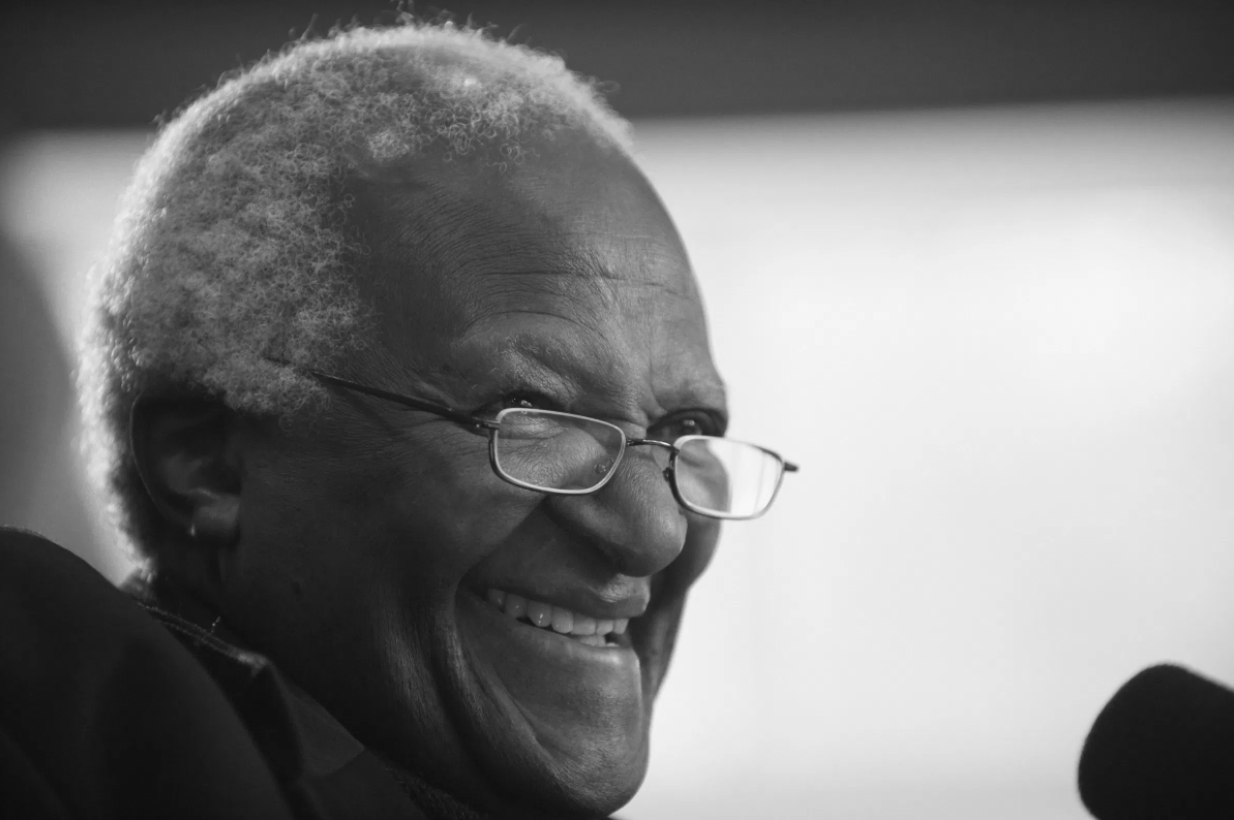
ARCHBISHOP DESMOND TUTU:
Surprise, forgiveness & healing
Rebecca is slightly obsessed with the On Being podcast series. One of this week’s highlights for her was listening to Krista Tippett’s interview with Archbishop Emeritus Desmond Tutu, entitled “A God of Surprises". Hearing Tutu talk about his work with South Africa’s Truth & Reconciliation commission is deeply humbling and has much to teach us today.
“There’s no question about the reality of evil, of injustice, of suffering, but at the centre of this existence is a heart beating with love.”